
Nonprofit Spotlight: Bernice Pauahi Bishop Museum

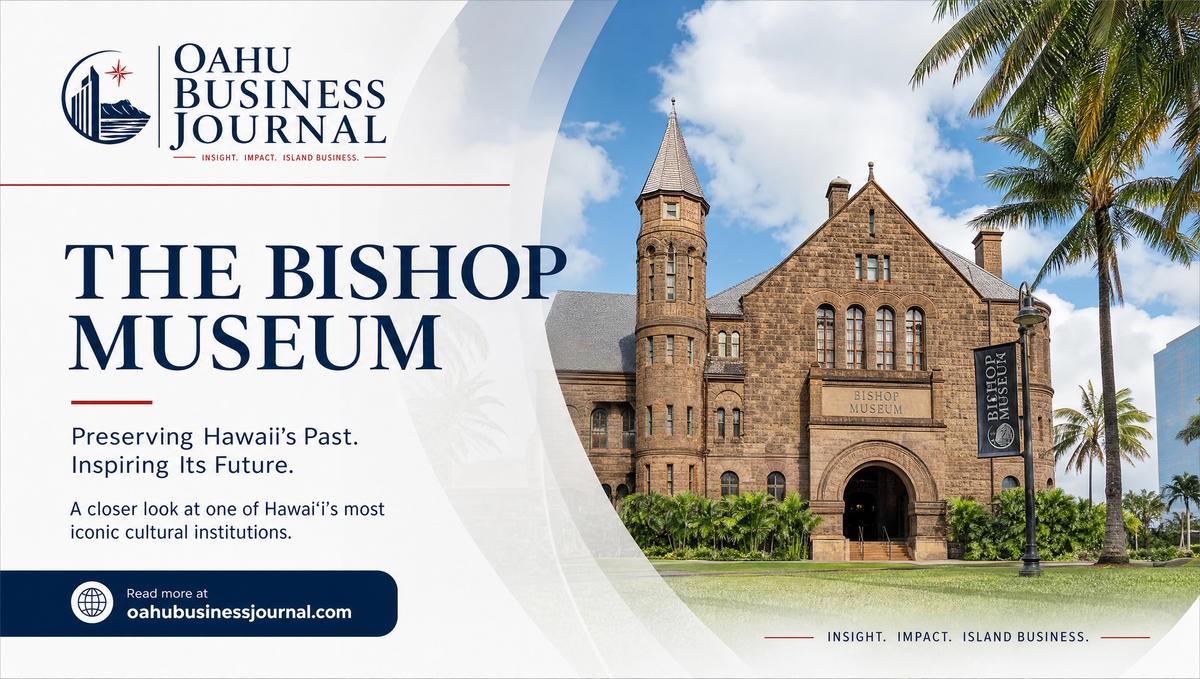
Oʻahu Business Journal | Nonprofit Business Profile
At a Glance
- Founded: 1889, by businessman Charles Reed Bishop in memory of his wife, Princess Bernice Pauahi Bishop, the last direct descendant of King Kamehameha I
- Address: 1525 Bernice Street, Honolulu, HI 96817 (Bishop Museum)
- Legal status: 501(c)(3) nonprofit; officially designated the State of Hawaiʻi Museum of Natural and Cultural History in 1988
- Annual visitors: More than 200,000
- Collection size: Over 25 million cultural, historical, and natural science objects (Bishop Museum)
- FY2023 revenue: Roughly $21.5 million, driven primarily by $18.3 million in contributions
- CEO: Kristofer Helgen, who took the helm August 1, 2025
Organizational Overview
For 137 years, the Bernice Pauahi Bishop Museum has operated as Hawaiʻi's largest cultural and scientific institution — part visitor attraction, part research powerhouse, and part steward of the state's most significant historical archive. Built on the original grounds of Kamehameha Schools, the museum was established to house the royal heirlooms of the Kamehameha and Kalākaua dynasties that passed to Bishop through his wife's estate (Bishop Museum FY2021 Annual Report).
Today the museum's stated mission is "to record, preserve and tell the stories of Hawaiʻi and the Pacific, inspiring our guests to embrace and experience our natural and cultural world." Beyond exhibits, Bishop Museum functions as a working scientific institution, with active research programs spanning marine biology, entomology, botany, and archaeology across the Pacific region.
Business Model and Finances
As a nonprofit, Bishop Museum runs on a mixed-revenue model combining admissions and program fees, membership dues, retail and rental income, and — most heavily — philanthropic giving and grants. According to its most recently filed IRS Form 990, for the fiscal year ending June 2023 the museum reported:
- Contributions and grants: $18.3 million
- Program service revenue: $2.98 million
- Rental property income: $454,278
- Total assets: $85.6 million against $13.8 million in liabilities
- Payroll: $1.16 million in reported executive compensation plus $8.06 million in other salaries and wages
That contribution-heavy revenue mix is a double-edged sword. New CEO Kristofer Helgen has noted that roughly 7% of the museum's operating budget currently comes from U.S. government sources, and that federal funding cuts hitting cultural institutions nationwide create real uncertainty for Bishop Museum's future budgets, even if he doesn't expect "draconian changes." To offset that exposure, the museum actively courts corporate and foundation partners, with a dedicated grants development office soliciting local and national funders (Bishop Museum Foundations page).
Admission pricing (as of recent listings) runs roughly $22.95–$25 for adult general admission, discounted to about $14.95–$15 for Hawaiʻi residents and military with ID, with members and children three and under admitted free.
Leadership Transition
Bishop Museum has weathered notable leadership turbulence in recent years. Its board terminated three top executives in January 2023, after which longtime healthcare and nonprofit executive Dee Jay Mailer stepped in as interim president and CEO. The museum launched a national search for permanent leadership in late 2024.
That search concluded with the hiring of Kristofer Helgen, a mammalogist and former chief scientist at the Australian Museum Research Institute with prior stints at the Smithsonian Institution and the American Museum of Natural History. Helgen, who first studied Bishop Museum's mammal collection as a Harvard student in 2002, was chosen from a pool of roughly 50 candidates and started as president and CEO on August 1, 2025.
Helgen has framed his early priorities around listening before acting: spending time with staff, learning Hawaiian culture and history, and prioritizing Hawaiian voices in decision-making, while also working to reduce admission barriers — he's expressed interest in lowering or eliminating the entry fee for Hawaiʻi residents and children. He also wants the museum to take on a bigger role in state biosecurity efforts, including combating invasive species.
Programs and Community Role
Bishop Museum's operations extend well past its Kalihi campus exhibit halls:
- Cultural stewardship and repatriation: The museum is actively involved in repatriating iwi kūpuna (ancestral Native Hawaiian remains) held by institutions outside Hawaiʻi — a process Helgen has called complicated and sensitive but central to the museum's mission.
- Scientific research: Staff scientists work in marine biology, conservation, and food security, with the museum positioning itself as having "significant global impact" through its Pacific-focused research.
- Biosecurity and conservation: The museum recently hosted a learning exchange with more than 20 local, national, and international organizations addressing invasive species and biodiversity protection, and it runs a captive-rearing program for endangered native snail species.
- Education and exhibits: Programs include the newly renovated Hawaiian Hall and rotating exhibitions such as "Ka ʻUla Wena: Oceanic Red," developed with support from the federal Institute of Museum and Library Services to center Indigenous Pacific culture and language.
- Fundraising and membership: The museum solicits tax-deductible donations, corporate partnerships, and foundation grants through a dedicated advancement office to sustain collections, research, and public programming (Bishop Museum Join and Give).
Why It Matters for Oʻahu's Economy
As one of the island's top cultural attractions, Bishop Museum is both a tourism draw — pulling in over 200,000 visitors annually — and a significant local employer, with more than $9 million in combined salaries and executive compensation reported in its most recent tax filing. Its research partnerships and biosecurity work also tie it into the state's broader conservation and agricultural economy, while its scale of philanthropic fundraising makes it one of Oʻahu's more prominent players in the local nonprofit and grant-making ecosystem.
Contact Information
- Address: 1525 Bernice Street, Honolulu, HI 96817
- Phone: (808) 847-3511
- Hours: Open daily, 9 a.m.–5 p.m. (closed Thanksgiving, Christmas Eve, Christmas Day, and New Year's Day) (Bishop Museum)
- Website: bishopmuseum.org
This profile is part of Oʻahu Business Journal's ongoing nonprofit spotlight series highlighting the organizations shaping Oʻahu's civic and cultural landscape.


